
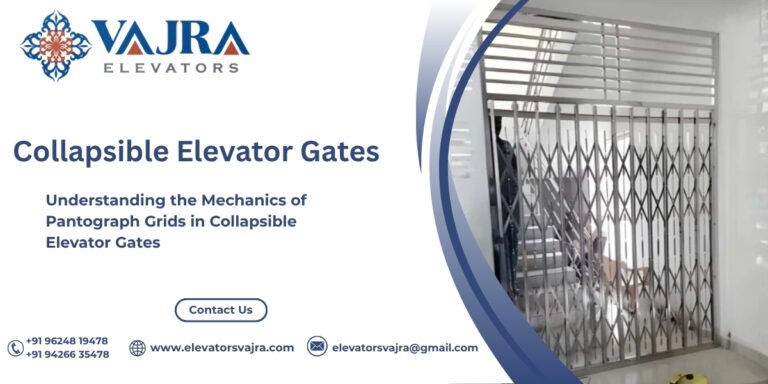
When you look at a traditional security gate on a classic passenger elevator, a freight lift, or a historic building modernization project, you instantly recognize its iconic diamond-shaped web pattern. Known in engineering terms as a pantograph grid, this ingenious scissor mechanism allows a heavy metal barrier to expand smoothly across an opening and collapse compactly back into a fraction of its width.
While it looks simple from the outside, the design and execution of a pantograph grid involve precise mathematical geometry and mechanical physics. For engineers and facility managers, understanding how these systems work is key to appreciating their durability.
The Geometry of Motion: How the Pantograph Works
A pantograph is a network of interconnected bars (pivoting links) arranged in a repeating parallelogram or diamond lattice configuration.
Uniform Force Distribution: When a user pulls or pushes a collapsible gate, the kinetic force is distributed evenly across every individual pivot point (rivet pin) in the entire lattice network. This ensures that no single section bears the brunt of the operational load.
Compact Storage: The true genius of the scissor grid lies in its space-saving ratio. A gate that extends several feet to completely seal an entrance can collapse into a tight stack taking up only a few inches of side clearance.
Critical Engineering Factors for Long-Lasting Gates
Because every pivot point in a pantograph grid experiences rotational friction during every single open-and-close cycle, manufacturing quality dictates lifespan:
Precision Rivet and Pin Engineering: The pins connecting the intersecting metal slats must be manufactured to exacting tolerances. If a pin is too loose, the gate will sag and rattle; if it is too tight, the scissor action will bind and jam.
High-Tensile Material Selection: Whether fabricated from rugged mild steel or corrosion-resistant stainless steel, the individual slats must possess high tensile strength to resist bending when lateral pressure or heavy impacts are applied against the closed gate.
(To examine ruggedly engineered, smoothly operating collapsible barrier solutions built to rigorous standards, explore our product categories for MS Collapsible Doors and SS Collapsible Doors.)
Maintenance Best Practices for Scissor Grids
To ensure a pantograph gate continues to glide effortlessly over years of heavy daily use, keep these maintenance rules in mind:
Lubricate Pivot Points Regularly: Apply light, non-staining oil or dry-film lubricant directly to the central rivet pins where the bars cross. Avoid heavy greases that attract dust and lint.
Check for Track Alignment: Ensure the top and bottom guiding channels are clean and straight, as a misaligned track forces the pantograph grid to twist unnaturally during expansion.
Conclusion
The pantograph grid is a masterclass in mechanical engineering—blending high structural security, smooth kinetic motion, and exceptional spatial efficiency into a timeless design.
Looking for robust, precision-engineered collapsible security gates for your building project? Contact our engineering team today.