
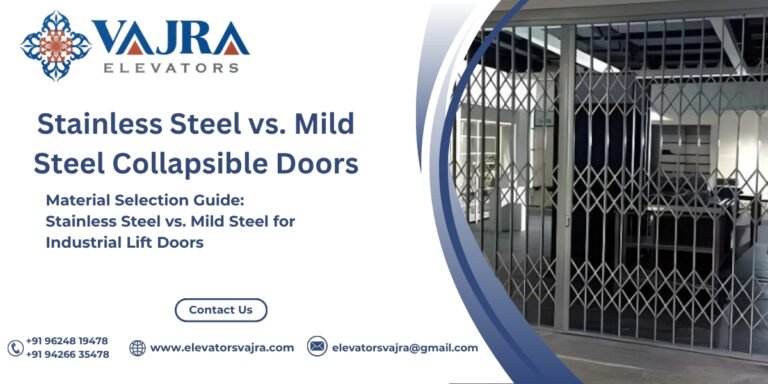
When specifying heavy-duty entrance systems for industrial plants, logistics warehouses, commercial freight hubs, or multi-storey parking complexes, the choice of raw material dictates everything. From day-to-day impact resistance to decades of corrosion defense, the metal you select forms the foundation of your facility’s vertical transportation safety.
Among the most trusted alloys used in industrial lift door manufacturing are Stainless Steel (SS) and Mild Steel (MS). Understanding the distinct properties of each helps engineers, builders, and facility managers make the optimal choice for their operational environment.
Understanding Mild Steel (MS): Strength and Economy
Mild steel is a carbon steel alloy containing a relatively low amount of carbon, making it exceptionally ductile, formable, and rugged.
High Structural Rigidity: MS offers incredible tensile strength, allowing heavy-duty frameworks and collapsible gates to absorb heavy operational stress without bending or fracturing.
Cost-Effective Scalability: For large industrial structures and high-volume freight systems, mild steel provides robust performance at a highly economical price point.
The Need for Surface Treatment: Because raw carbon steel is susceptible to oxidation and rust when exposed to moisture, MS components must be protected with industrial-grade powder coating, galvanization, or specialized anti-corrosion primers.
(To view robust, high-strength industrial solutions built with mild steel, explore our specifications for MS Collapsible Doors and Goods Lift Doors.)
Understanding Stainless Steel (SS): Ultimate Corrosion Resistance
Stainless steel is an alloy containing iron, chromium, and other trace elements like nickel, which react with oxygen to form a passive, self-healing protective surface layer.
Superior Corrosion Defense: SS naturally resists moisture, chemical exposure, and high-humidity environments without requiring heavy external coatings, making it ideal for food processing plants, chemical facilities, or coastal buildings.
Sleek Aesthetic Appeal: With a polished or brushed finish, stainless steel delivers a modern, high-end look suitable for executive commercial lobbies and luxury passenger elevators.
Long-Term Low Maintenance: The absence of surface paint means no peeling, chipping, or frequent touch-ups, reducing lifetime maintenance overhead.
(To explore premium stainless steel engineering designed for elite architectural standards, review our product lines for SS Collapsible Doors and Passenger Lift Doors.)
Comparing the Two: Which Should You Choose?
Choose Mild Steel when your project demands maximum structural muscle on an optimized budget, especially for interior warehouses, factories, or freight applications where protective finishes can be easily maintained.
Choose Stainless Steel when operating in moisture-heavy, corrosive, or high-visibility environments where flawless aesthetics and zero-rust longevity are top priorities.
Conclusion
Choosing between stainless steel and mild steel isn’t about finding the “better” metal—it’s about matching material physics to your building’s precise environmental and structural demands.
Need expert guidance on selecting the ideal material specifications for your upcoming project? Contact our engineering team today.