
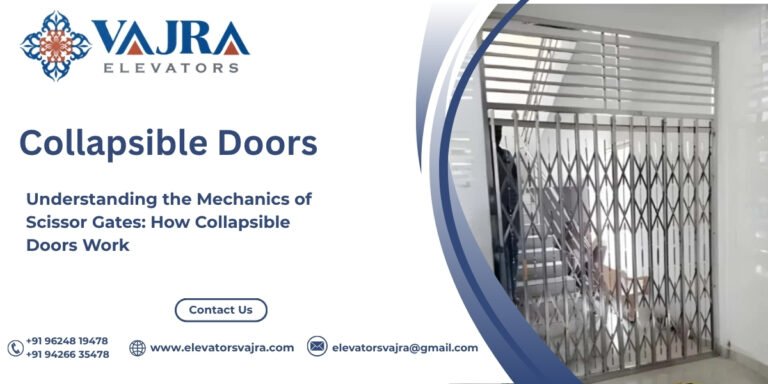
When stepping into older commercial buildings, heritage properties, or heavy-duty industrial goods lifts, one of the most recognizable features is the traditional expanding gate. Often referred to as scissor gates or retractable barriers, these systems play a critical role in vertical transportation safety. But have you ever wondered about the physics and mechanics that allow a solid-looking metal barrier to smoothly fold and expand?
In this technical breakdown, we explore the engineering principles that keep collapsible doors operating reliably.
The Geometry of the Diamond Lattice
At the heart of every manual or semi-automated collapsible gate is a geometric pattern known as a pantograph or diamond lattice framework.
The Pivot Points: The structural integrity relies entirely on precision-engineered rivets or pins connecting intersecting metal slats.
Force Distribution: When manual or mechanical force is applied to open or close the gate, the diagonal bars distribute the load evenly across the entire vertical height of the frame. This prevents warping and ensures the door moves uniformly along its guide tracks.
Guiding Systems: Top Track vs. Bottom Track Mechanics
A collapsible door is only as smooth as its tracking system. The movement relies on a dual-track configuration:
The Top Suspension Track: Typically carries the primary weight of the gate assembly. Precision rollers or sliding blocks sit inside an enclosed overhead track, minimizing friction.
The Bottom Guide Channel: Acts as a stabilizing guide to prevent lateral swaying. In industrial environments, keeping this bottom channel clear of debris is essential for uninterrupted motion—a topic we frequently discuss in our guide on goods lift safety standards.
Material Engineering: Why Choice of Metal Matters
Because these gates undergo thousands of expansion and contraction cycles daily, the choice of raw material dictates their lifespan:
Mild Steel (MS): Offers high tensile strength and rigidity, making it ideal for robust industrial applications where structural resilience is paramount.
Stainless Steel (SS): Provides superior corrosion resistance and a polished architectural look, making it the preferred choice for commercial spaces exposed to variable humidity.
(If you are planning a new installation, you can review our technical specifications for SS Collapsible Doors and MS Collapsible Doors to see which material fits your environment.)
Maintenance and Smooth Operation
To ensure a scissor gate maintains its fluid motion over years of operation, routine maintenance should focus on:
Pivot Lubrication: Applying the correct grade of lubricant to rivet joints prevents binding and reduces metal-on-metal wear.
Track Alignment Checks: Periodic inspection of overhead hangers ensures the door does not tilt or drag against the threshold.
Conclusion
The simple appearance of a expanding metal gate hides a sophisticated exercise in kinematics. By understanding how load distribution, pivot engineering, and tracking systems work together, building managers and contractors can better appreciate the value of precision-manufactured entrance solutions.
Have a question about integrating custom-sized access solutions into your building project? Contact our engineering team today to discuss your exact requirements.